
Reviewed · UBUD BALINESE COOKING CLASSES
Ubud Cooking Class Bali with Balinese Chef
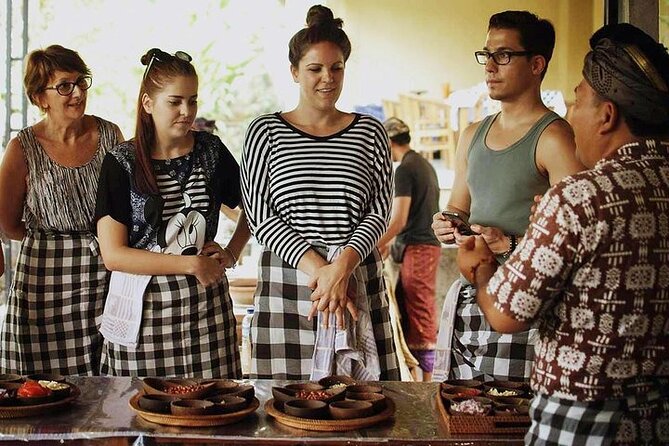
The best part of this Ubud class is simple: you do the cooking. With your own station, utensils, and ingredients, you prepare seven Balinese dishes under the guidance of an English-speaking local chef, then sit down to eat the results. The morning market visit adds a useful look at everyday ingredients before the lesson begins.
I especially like the fully hands-on format and the choice between vegetarian and non-vegetarian menus. I also like that the class includes sauces, spice paste, a main dish, noodles, and dessert, so you learn more than one isolated recipe. The main drawback is that hotel pickup is limited to central Ubud for the morning class, and the group may include up to 24 people.
Key points before you book
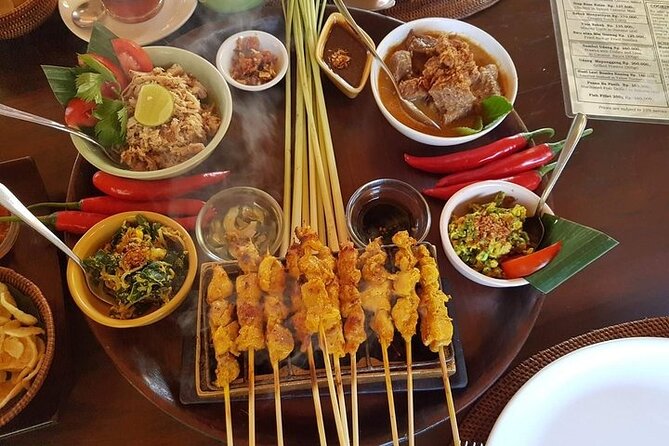
- Seven dishes from one cooking session: You prepare sauces, spice paste, a main course, satay, noodles, and dessert.
- A real choice of menus: Select vegetarian dishes with tempe and tofu, or a non-vegetarian menu with chicken and fish.
- Morning market access: The 30-minute traditional market tour is included with the morning class only.
- Your own cooking station: You handle the cooking with provided utensils, ingredients, and cookware.
- A meal at the end: Lunch or dinner is made from the food you prepared during class.
- Central Ubud transport rules: Morning pickup and return are included in central Ubud, while other areas cost extra.
Why this Ubud class feels more useful than a standard food demonstration
Many cooking lessons leave you watching a chef work while you take a few turns with a knife or spoon. This one is designed differently. You receive your own cooking station and utensils, then prepare the menu yourself from start to finish.
That matters if you want to repeat the dishes at home. You are not simply tasting finished food. You are working through the sauces, spice paste, frying, grilling, and banana-leaf cooking that give Balinese food its character.
The class is conducted in English, and the chef leads you through the process step by step. One instructor named in the experience is Made, who is described as entertaining and clear in his teaching. Other staff members assist during the class, which should help keep a larger group moving.
The cooking format also gives you a better feel for how Balinese meals are built. Instead of focusing on one famous dish, the menu covers several small components that work together. You prepare the foundation, the protein or vegetable dishes, the noodles, and the sweet finish.
More Balinese cooking classes in Ubud:
- PRIVATE Authentic Balinese Cooking Class in Ubud at Putu’s Home
★ 5.0 · 644 reviews - Balinese Ubud cooking school (9 Dish Cooking and Market Tour)
★ 5.0 · 540 reviews - Balinese Farm Cooking Class by Pemulan Bali
★ 5.0 · 410 reviews
The morning begins at Ubud Traditional Art Market
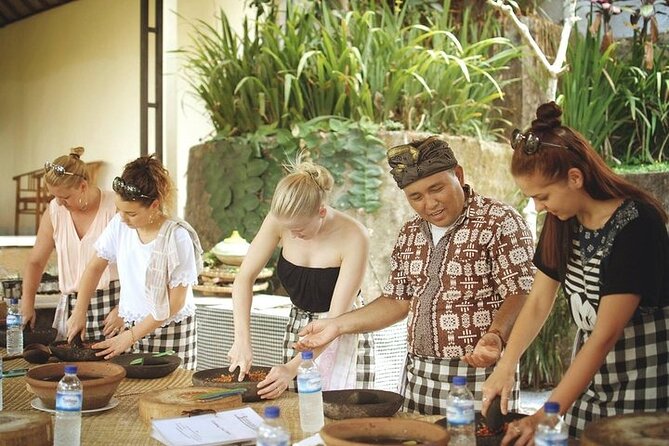
Choose the morning session if you want the market visit. The tour spends about 30 minutes at Ubud Traditional Art Market before continuing to the cooking class.
This is not a long shopping stop, and personal market purchases are not included. Think of it as a short introduction to the produce, spices, and food items used in Balinese cooking. It helps put the lesson in context before you start chopping and mixing.
I like this part because ingredients make more sense when you see them in their local setting. A cooking class can otherwise feel like a sealed-off activity. The market adds a connection between the food on the table and the daily life of Ubud.
The timing also matters. The market tour is available for the morning trip only, so an afternoon booking does not provide the same full schedule. If the market is important to you, confirm that you are choosing the morning option.
The cooking menu gives you a proper Balinese meal
The class offers two menus. Both include seven dishes, the same sauces and dessert, but the central dishes differ.
The vegetarian menu includes:
- Sauce Kacang, a peanut sauce
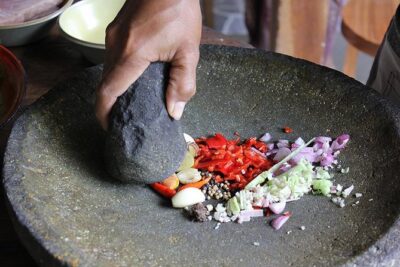
- Bumbu Bali, a Balinese spice paste
- Kare Sayur, vegetable curry
- Tempe, tofu, and vegetable satay with peanut sauce
- Pepes Mushroom, mushrooms grilled in banana leaf
- Mie Goreng, fried noodles
- Kolak Pisang, braised saba banana in palm sugar gravy
The non-vegetarian menu includes:
- Sauce Kacang, a peanut sauce
- Bumbu Bali, a Balinese spice paste
- Ayam Bumbu Bali, Balinese fried chicken
- Chicken satay with peanut sauce
- Pepes Ikan, fish grilled in banana leaf
- Mie Goreng, fried noodles
- Kolak Pisang, braised saba banana in palm sugar gravy
This is a well-shaped menu for a four-hour activity. You get a sauce, a spice base, a vegetable or meat dish, satay, a banana-leaf preparation, noodles, and dessert. The range means you learn different cooking methods rather than repeating the same technique seven times.
The vegetarian menu is not an afterthought. Tempe, tofu, mushrooms, and vegetables give it its own structure, while the peanut sauce and spice paste keep it connected to the wider Balinese menu. If you do not eat meat, this option still offers plenty of hands-on work.
The non-vegetarian menu gives you both chicken and fish, along with two different preparations. Chicken is fried and used in satay, while fish is grilled in banana leaf. That gives you a useful comparison of how the same cuisine handles different proteins.
Your own station keeps the lesson active
Cooking ware, utensils, ingredients, and a welcome drink or mineral water are included. The important detail is that you do not simply watch a communal demonstration. You prepare the dishes yourself at an individual station.
That setup is especially useful for anyone who wants practical instruction. You can follow the process directly, ask questions in English, and see how each component comes together. The class is intended to be accessible to most participants, and the staff assist as the cooking progresses.
The size can reach 24 people. That is not an intimate private lesson, so you should not expect constant one-to-one attention. Still, additional people are available to assist, and the class structure gives each participant a defined place to work.
Past participants have particularly praised the clear instructions, helpful assistants, and entertaining teaching style. One useful sign is that people describe the recipes as easy to try again at home. That is the test I would use for any cooking class: can you remember what you did once you leave?
A completely different kind of day out from Ubud:
- All-Inclusive Ubud Private Tour
★ 5.0 · 14,344 reviews - Best of Ubud Full-Day Tour with Jungle Swing
★ 5.0 · 8,571 reviews - Ubud: Monkey Forest, Jungle Swing, Rice Terrace, and Water Temple
★ 5.0 · 7,160 reviews - Best of Ubud 1-Day Private Tour
★ 5.0 · 4,451 reviews
Eating your own work is part of the lesson
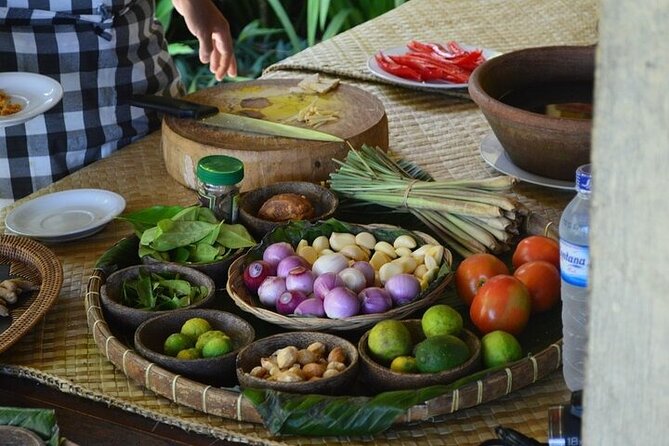
After the cooking, you eat the dishes you prepared for lunch or dinner in the dining room. This meal is included, but other beverages are not.
The shared meal gives the class a natural finish. You can taste the sauce, curry, satay, noodles, and dessert together instead of judging each item in isolation. It also lets you see how the separate dishes work as one Balinese meal.
The included food adds real value to the price. At $35.79 per person, you are paying for roughly four hours, instruction, ingredients, cookware, a possible market visit, transport within the stated area, and a full meal. It is not just a short recipe demonstration followed by a small tasting.
The meal is also practical for anyone planning a busy Ubud day. A morning class ends with lunch, while an afternoon session leads into dinner. Since the schedule is approximately four hours, leave enough room around it rather than placing a tightly timed activity immediately afterward.
Morning or afternoon: choose based on your priorities
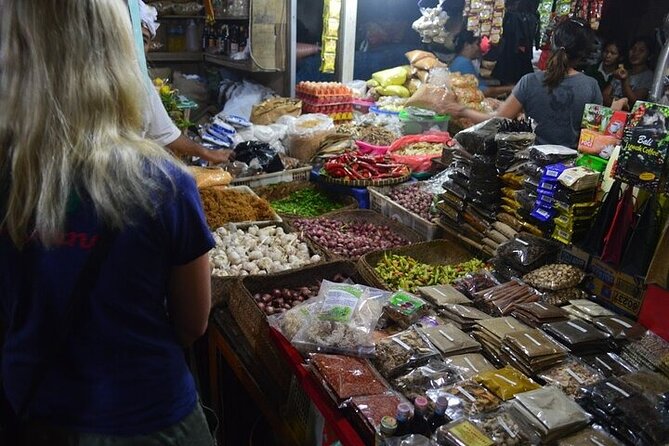
The morning class is the fuller option. It includes the 30-minute market visit and return hotel transfer for central Ubud. If you want the market, the included transport, and a complete morning-to-lunch plan, this is the one to choose.
The afternoon class begins at 2:30 p.m. at the front of Lapangan Desa Ubud, which is the stated meeting point. The return is included from there, but the market tour is not part of the afternoon schedule.
The afternoon choice may suit you better if your morning is already occupied or you prefer cooking later in the day. Just remember that pickup arrangements differ. Hotel pickup is offered for the morning class in central Ubud, while the afternoon option uses the stated meeting point.
Pickup from areas outside central Ubud is not included in the standard arrangement. An extra charge of up to IDR 600,000 per car may apply for cooking-class pickup from other areas. Check this before booking, since it can change the total value for a small group.
What the transport arrangement means in practice
Return hotel transfer is offered for the morning class in central Ubud only, using a shared car. This is convenient if your accommodation falls inside the stated area, but you should not assume that every Ubud address qualifies.
For the afternoon class, meet at Lapangan Desa Ubud at 2:30 p.m. The information provided identifies this as the pickup point, so plan to reach it on your own. The return is included from there.
The transport limits are not a major problem, but they are easy to overlook. If you are staying outside central Ubud, add the extra car cost to your calculation. If you are staying centrally, the included transfer makes the morning session a better deal.
Who will get the most from this class
This is a strong pick for you if food is one of the main reasons you visit Bali. The class gives you direct practice with local dishes rather than only a restaurant meal.
It also suits couples, families, and small groups who want an activity with a clear result. Group discounts are available, though the amount is not specified, so ask about the current terms if you are booking for several people.
Vegetarians have a proper menu, not merely a substitution. People who want meat and fish receive a broader protein-based menu. The class is conducted in English, making it a practical choice for English-speaking visitors who want to ask questions while cooking.
It may be less suitable if you want a private, quiet lesson. The group can reach 24 people, and the format is social. The class also requires good weather, so poor conditions can lead to a different date or a full refund.
Small details worth knowing before booking
Confirmation is provided at the time of booking. Most people can participate, but the supplied information does not give a detailed accessibility description, so contact the provider if you have specific mobility or dietary needs.
Personal expenses at the market are not included. Beverages beyond the welcome drink or mineral water are also extra.
The experience is non-refundable and cannot be changed for any reason after booking. If bad weather cancels the class, you are offered another date or a full refund. The same choice applies if the minimum number of participants is not reached.
The activity has a maximum of 24 participants. That cap keeps the class from becoming unlimited in size, but it still means the experience may feel more like a group workshop than a private lesson.
Is the $35.79 price good value?
For a four-hour activity, the price is fair, especially if you use the morning option. The package includes the chef, ingredients, cookware, seven dishes, a meal, and central Ubud return transport. The market tour adds another useful element at no separate admission cost.
The strongest value comes from the hands-on format. You are paying for instruction you can use later, not only for food you eat once. The sauces, spice paste, satay, banana-leaf dish, noodles, and dessert give you a broad introduction to Balinese home-style cooking.
The value is weaker if you need transport from outside central Ubud and face the extra car charge. It is also less compelling if you dislike group activities or want a private chef lesson.
Still, for most food-focused visitors in Ubud, the cost covers a substantial half-day plan. You leave fed and with a set of recipes and techniques to try again.
Should you book this Ubud cooking class?
Book it if you want to cook rather than watch, prefer a choice of vegetarian or non-vegetarian dishes, and like the idea of eating your own lunch or dinner. Choose the morning session if the market and included central Ubud pickup matter to you.
Think twice if you need a private class, have strict transport needs outside central Ubud, or cannot accept a non-refundable booking. For everyone else, this is a practical, good-value way to spend four hours learning how Balinese meals are built, one sauce, spice paste, satay, noodle dish, and banana-leaf parcel at a time.
FAQ
How long does the Ubud cooking class last?
The experience lasts approximately four hours, including the market visit when you book the morning session.
Is hotel pickup included?
Return hotel transfer is included for the morning class from hotels in central Ubud only, using a shared car. Pickup from other areas may cost up to IDR 600,000 per car.
Where does the afternoon class meet?
The afternoon class meets at 2:30 p.m. in front of Lapangan Desa Ubud, which is the stated pickup point.
Is the traditional market visit included?
Yes, the 30-minute visit to Ubud Traditional Art Market is included with the morning trip only.
Can I choose a vegetarian menu?
Yes. The vegetarian menu includes peanut sauce, Balinese spice paste, vegetable curry, tempe, tofu, vegetable satay, grilled mushroom in banana leaf, fried noodles, and braised banana dessert.
What is included in the non-vegetarian menu?
The non-vegetarian menu includes peanut sauce, Balinese spice paste, Balinese fried chicken, chicken satay, grilled fish in banana leaf, fried noodles, and braised banana dessert.
Are ingredients and cooking equipment provided?
Yes. Cooking ingredients, cooking ware, and utensils are included.
Is the meal included after the class?
Yes. You eat the lunch or dinner prepared during the cooking class. Beverages other than the welcome drink or mineral water are not included.
Can I cancel or change my booking?
The experience is non-refundable and cannot be changed for any reason. If the class is canceled because of poor weather or because the minimum number of participants is not reached, you are offered another date or a full refund.
More craft workshops in Ubud
- Ubud Silver Class Jewelry making in bali
★ 5.0 · 978 reviews - Ubud Monkey Forest Silver Class – Craft Your Own Silver Jewelry
★ 5.0 · 254 reviews - Balinese Authentic Cooking Class in Ubud
★ 5.0 · 239 reviews - PRIVATE Balinese Cooking Class in Ubud with Dewa with Transfers
★ 5.0 · 213 reviews
Newly added Ubud trips
- authentic Balinese organic cooking class in Ubud★ 5.0 · 4 reviews
- Farm-to-Table Balinese Cooking Experience★ 4.0 · 3 reviews
- Sunrise Jeep Tour Mount Batur Kintamani Bali★ 5.0 · 24 reviews
- coconut wine and coffee safary tour★ 5.0 · 16 reviews
- Nungnung Waterfall,Jatiluwih Heritage UNESCO and Bedugul Tour★ 5.0 · 5 reviews
- Bali Amazing Cycling Tour★ 5.0 · 4 reviews
- Bali Rural Village Bike★ 5.0 · 10 reviews
- Authentic Balinese Cooking Class with Jewelry Making Class★ 5.0 · 3 reviews
Ubud Balinese Cooking Classes, compared.
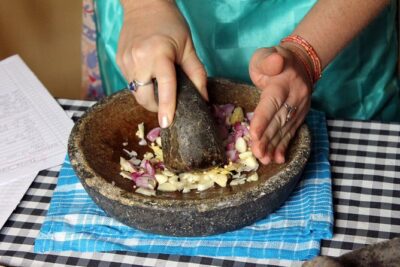
PRIVATE Authentic Balinese Cooking Class in Ubud at Putu’s Home
Read our review →
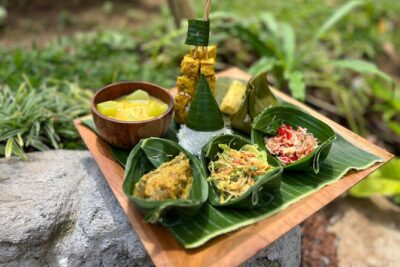
PRIVATE Balinese Cooking Class in Ubud with Dewa with Transfers
Read our review →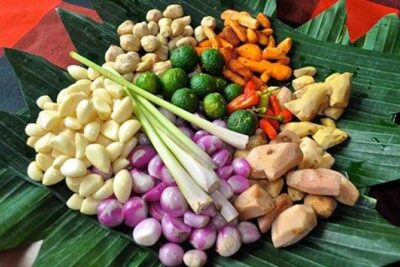
Balinese Cooking class with traditional morning market visit
Read our review →
PRIVATE Ubud Market Tour & Balinese Cooking Class with Putu
Read our review →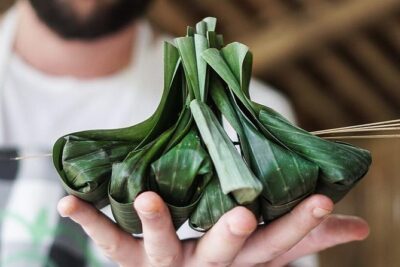
Authentic Bali Farm Cooking School & Organic Farm
Read our review →Browse the lists this tour appears in